MONTH-END CLOSE
Integrated Review Tools
Close Page
AI Bank Feeds
Ask Double
1099 Management
Reports
Receipts
Accruals
AI Transactions
CLIENT & PRACTICE MANAGEMENT
Inbox
Client Portal & App
Client Database
Tax

JEA Financial (JEA) keeps the books for e-commerce brands, which is a specialty for a reason. Erica Day founded the New Jersey firm and has grown it to just over 50 clients and a team of around 15, including 12 bookkeepers and 3 client success managers. Alongside bookkeeping, JEA does fractional CFO work and financial coaching, a lot of which is aimed at getting an owner's true cost of goods sold right so they can price for their own seasonality. "We love the complexity of e-commerce," Erica said.
JEA was created around a specific philosophy and inspired by a trend we’ve all seen: founders not paying themselves enough or investing thoughtfully in their financial future. Before JEA, Erica ran high-end newborn photography studios that grossed about $1 million a year, while she paid herself a salary of about $25,000. When COVID closed the studios she went back to her finance degree, became a Profit First professional, and rebuilt her career around the problem she had lived herself.
Her clients now include e-commerce brands that posted losses for years and today net six to seven figures in gross profit. Double's AI Transactions feature, which reads an uploaded file and drafts entries for QuickBooks Online, and the reusable skills JEA built on top of it are what let 15 people carry that kind of work across 50 books.
I brought my own life experience of having what looked like a successful business on the outside, but wasn't financially successful on the inside, and turned it into a business to help other entrepreneurs out of that problem.
JEA's clients depend on getting their cost of goods sold (COGS) right, and that starts with a distinction a lot of e-commerce sellers never learn: a factory invoice isn't an expense the day it's paid. Inventory hits the balance sheet the moment it's received in the warehouse, and it sits there as an asset until the units actually sell, and only then does it move to the income statement as cost of goods sold. For sellers with multiple vendors, this is a lot of bills to enter each month. Entering these bills manually, or even using the QuickBooks Online bill email, is time consuming and not automated. Double’s AI skills have improved this process significantly for JEA’s team.
"We love inventory puzzles," Erica said, and that's the puzzle JEA solves for every client: making sure every factory bill hits the inventory account at the right time and only moves to COGS as it's sold, so the margin an owner sees is the margin they actually have. Because JEA's clients manage purchase orders (POs) outside QuickBooks, that factory bill also needs to be traceable back to the order that created it. Double's AI Transactions skill reads the invoice, applies the right class, adds the PO number to the bill as a $0 line item, and checks its own math against the invoice total, so the PO becomes searchable inside QuickBooks itself, instead of living in a separate system.
Erica heard about Double from another firm owner at a small conference retreat for bookkeepers and accountants in Canada. Initially, she was shopping for a CRM and a way to communicate with clients. "I think I was signed up before the end of the week, before we even left Canada," she said, and what she found went well past the two tools she originally went looking for.
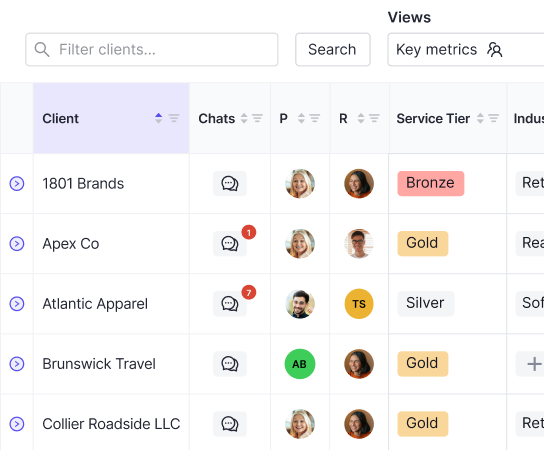
Double took over JEA's CRM, Clockify for time tracking, the database holding its SOPs, and its project management software. The time tracking earns its keep because Erica can see which clients are profitable and where someone is over-servicing a file. Financials now go out through the JEA-branded client portal rather than as PDFs and Excel files dropped into a Google Drive folder, which Erica mentioned is "definitely more of a high-end look for us."
Erica has built most of JEA's AI skills herself, recording a video of each one so the team can eventually learn to build their own. Four of them carry the most weight every month:
Factory invoices and purchase orders. JEA's clients manage POs outside QuickBooks, which makes them hard to find again later. The skill reads the factory invoice, applies the right class for the brand it belongs to, adds a line item per SKU, and drops the PO number in as a $0 line so it becomes searchable inside QuickBooks. Then it checks its own arithmetic against the invoice total.
The Shopify bill QuickBooks doubles. Sent straight to QuickBooks, a Shopify bill "always doubles," Erica said, and the shipping, software fees, and merchant fees buried inside it stay lumped together. JEA's skill splits the three into their own categories and confirms the total matches the bill.
ADP payroll, split the way the business runs. ADP does not break labor out the way JEA's clients need it. For construction clients, hours worked at a customer’s job site have to bill to that project, so the team uploads the ADP invoice alongside the project list and the skill in Double marries them. For one e-commerce client, the same approach splits payroll across the warehouse, the retail location, and the people running the business.
Month-end statements. Working capital loans, Shopify loans, and mortgages go through Double’s AI Transactions module at month end to have principal and interest broken out. JEA also uses Double to reconcile clearing accounts for several marketplaces and merchant providers (like Faire, Zip, Loop Returns, and others) that take out commissions and other fees not captured inside Shopify.
Erica tracks time in Double, giving her a full view of how her business is doing in any given month. Her own analysis put close time down 30% for some clients since implementing Double. Add it up and Erica estimates Double gives back 1 to 2 hours per client per month. Across just over 50 clients she puts the firmwide figure at 100 hours or more every month, close to 1,200 hours a year.
Where those hours land depends on who was doing the work. The bookkeeping team is paid hourly, so every hour reduced is a dollar that can go back into investing in the firm. The client success managers are salaried, so their recovered hours become capacity for more clients. That added capacity gives JEA the ability to deliver even more value, like better looking reports and more time spent digging into the financials rather than racing to close.
Double has actually allowed us to add additional value to each client because the same team can do more.
The per-client pricing is something that Erica always points to when she talks to industry peers considering Double for their practice. The way she sees it, if you bill $150 an hour and $10 a month buys one of those hours back, you have already won.
If you can't justify something that would save you an hour of time a month for $10, then, you need to look at your pricing.
The thing that has changed at JEA is where Erica's expertise sits. She knows a Shopify bill hides three kinds of cost, that a factory invoice needs a class and a searchable PO number, and that construction labor belongs to the project site it happened at. Before the skills existed, all of that lived in her head and in the training she passed along by hand. Now it lives in Double, running the same way every time for every bookkeeper; or even on a client file Erica may never look at herself.
This peace of mind is coupled with time savings and capacity expansion. 1 to 2 hours per client might sound small… until you multiply it across 50 books and hand the result to three client success managers with room to take on more. For a firm that competes on advisory work rather than data entry, the saved hours are the means to an end.
New things are hard. It's hard to go into a new system, but we have to innovate to stay competitive. So we need to make sure that we're reducing our time spent on each client.
Ready to give your team back a hundred hours each month? See what Double can do for your team.