MONTH-END CLOSE
Integrated Review Tools
Close Page
AI Bank Feeds
Ask Double
1099 Management
Reports
Receipts
Accruals
AI Transactions
CLIENT & PRACTICE MANAGEMENT
Inbox
Client Portal & App
Client Database
Tax

Cain Watters & Associates (CWA) is a leading financial advisory firm serving the dental industry, and a regular on the Accounting Today and IPA Top 100 lists. It aims to be a dentist's one stop shop: practice accounting, business and personal financial planning, tax, wealth management, practice transitions, insurance, and more. Two and a half years ago, CWA acquired CFO Ortho, a team already running its month-end on Double.
Brandon Tempest came over from CFO Ortho and now handles onboarding and client consulting. Paulo Souza runs the Utah accounting department, where eight accountants close roughly 480 client files on a monthly or quarterly basis. Several months in, and neither of them can imagine their workflows without Double.
We wouldn't be able to get rid of Double. This has become like the lifeblood of our accounting system.
- Brandon Tempest, Cain Watters & Associates
Before the acquisition, CFO Ortho first brought Double in to solve a review problem. A team in India did all of the transaction coding, and the plan was to keep it that way while US accountants moved up into higher-level review. But that only works if a manager can verify offshore work fast, and Brandon was met with what he called “a quality control problem”: there was no good way to confirm the data entry was right without spending a large chunk of his day inside QuickBooks. With a trained eye, Brandon could open a file and spot a strange P&L on instinct. But what he could not see was the layer underneath, where specific vendors may be categorized incorrectly.
Everything around the work was scattered, too. Client questions went out as one-off emails, and answers came back slowly enough to hold books open for weeks. Close checklists lived in Canopy, which had dashboards but never touched the ledger. "You're going through a checklist that is not talking in any way, shape, or form to what's going on in the actual ledger," Brandon said.
Paulo had experienced a rougher version of this at an earlier firm with no software at all: a spreadsheet per client, tabs listing what needed reviewing, rows turning green as people finished. "I had to log in every day to that spreadsheet for that specific client, just to see where they were at," he said. Running 480 files that way, by his estimate, would take triple the headcount and countless extra hours.
Templates that make 85% of a close automatic. Brandon built the firm's first client templates and he and Paulo have sharpened them ever since. Every client is created with the same core task set, which leaves a much smaller problem to solve. "Our team just has to pick up that 15% that is different for every client," Paulo said. Most of the 2 hours saved per client comes from here, because the review happens inside Double rather than in a browser full of tabs.
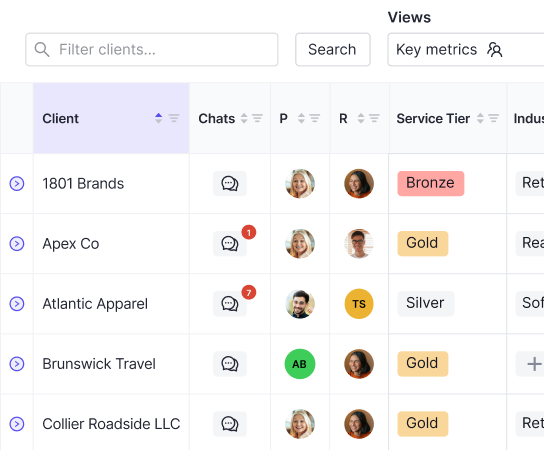
Views built by the people who use them. Paulo built the first dashboards, then taught the team to build their own, so every accountant opens a personal daily list: what to finish, how much of the close is done, which questions came back from the client, etc. Having it all a click away saves Paulo 20 to 30 minutes on every file he reviews, because he knows his team has their workflow under control.
Questions in the portal instead of the inbox. Improved client communication is the one that Brandon calls a game changer. CWA walks every client through the portal during onboarding, and from that point most responses land within 48 hours of reaching out. Because Double shows when a client last logged in, a quiet client is diagnosable rather than a mystery: either they are not looking, or they are looking and stalling. The result is simple: nobody on the accounting team sits in limbo waiting on information that may never arrive.
The piece Paulo is proudest of started as a management issue. Every client moves through the same status flow in Double, and because Double keeps its API open, Paulo pulls that movement into a monthly scoreboard for each accountant: what got finished, what came in late, how many revisions a file took. He built it to manage the team, and the team adopted it as their own. "The team loves it. They want to see how they're doing," Paulo said. Staff accountants customize it to track their own progress, and it feeds year-end reviews.
Brandon's team uses the same API to feed other firm systems, so planners can see when books closed without ever opening Double. Then the scoreboard traveled further than anyone planned: Cain Watters' CFO got wind of what Paulo created, and he is now trying to use similar metrics across the entire company for his own accounting purposes.
It just goes to show how powerful Double is with the data that you can pull out of it.
- Brandon Tempest, Cain Watters & Associates
If you ask Paulo where Double shows additional value, he’ll tell you about a client changing payroll providers. Oftentimes when this happens, transactions start landing in accounts they should not, and in the old setup somebody found it weeks later if they were lucky. But when reviewing inside Double, the misrouted entries surface while the close is still open.
The same risk exists in cases like a dental practice building a new office, where large loan draws move through the file in large, irregular amounts that are easy to miscode. Double flags them for a second look, which has quietly rewired the team's instincts. "It's almost an auto-trigger for them to ask the clients, or to think twice before they post something," Paulo said.
Cleanups are Brandon's favorite use case. The team categorizes a messy year as best it can, then runs the same review tools back over its own work to catch any anomalies. What used to stall a cleanup was the friction of asking the client anything, because that meant drafting an email and assembling the context by hand. But now, it’s never been easier for CWA to get what they need from clients.
There's no longer an excuse to not ask a client the question because it's just so easy.
- Brandon Tempest, Cain Watters & Associates
The capacity math is the kicker. Since the start of 2025, the Utah portfolio grew from about 350 clients to 480 while the close team grew from 6 accountants to 8. Each accountant now carries close to 60 files, and most finish their closes by the 15th to 20th of the month. Only three people touch any given client: the India team handling the data entry, the US accountant reviewing and reconciling, and Paulo signing off.
This lean model allows quality to hold as the client book grows, and what Paulo credits to Double is that everyone can see their own numbers, which turns the monthly close rate into something the team competes on.
We are not pressed to hire – because of all the efficiencies we’ve created in Double.
- Paulo Souza, Cain Watters & Associates
Paulo's advice to a peer is to stop deliberating and start small. "Don't be afraid to try something," he said. Pick a few clients, keep the initial setup simple, and let the software make its own case. Double sells itself once people actually start using it.
Brandon speaks to the fear every large firm has: that a new implementation automatically means a year of pain. With Double, however, that’s not the case. His team trained every employee alongside Double's customer success team, and after about two months of live closes they had it down. Savings showed up in the first month, most obviously on client communication, and kept surfacing at six and eight months in.
To this day, the thing that stands out at CWA is where the work actually lives. The India team codes in Double. The US accountant reviews in Double. Paulo signs off in Double, then pulls the data back out to show each teammate how their month went. An orthodontist across the state answers a transaction question in Double’s portal on a Tuesday night, and a close that could have sat open for weeks is delivered right on time instead.
That consolidation and visibility means something. It is a 480-client CAS department behaving like a much leaner one, month after month, because everyone is finally looking at the same page.
That's where it starts and that's where it ends. We start the close process and everything in Double, and then we finish in Double.
- Paulo Souza, Cain Watters & Associates
Ready to run your whole close on one system? See what Double can do for your team.