
Categorizing transactions, chasing down stray line items, writing variance explanations line by line. If that's still eating your week, you're not behind, you're just running the old version of the job. AI is already handling a good chunk of that, and this guide covers where it's making a real difference, where it falls short, and what your role looks like once the data prep disappears.
TLDR:
- AI in accounting handles categorization, reconciliation matching, and journal entry drafting, cutting data prep so your time goes toward analysis
- Accounting firms using AI-powered tools report 30 to 50 percent time savings per close, based on per-close documented results
- According to the AICPA and CIMA Future-Ready Finance Survey, 88% of finance professionals see AI as consequential, yet only 8% feel prepared to use it
- AI augments accountant judgment instead of replacing it; the accountant reviews output, approves numbers, and owns every final sign-off
- Double executes categorization, journal entries, and reconciliation matching through two-way ledger sync, posting results directly back to QuickBooks Online and Xero
What Is Artificial Intelligence in Accounting
Artificial intelligence in accounting refers to software that uses machine learning and language-understanding algorithms to execute financial tasks that once required manual data entry and judgment calls: categorizing bank transactions, extracting data from invoices and receipts, matching reconciliations, and drafting variance explanations for financial statements. Unlike static rules-based automation, these models learn from historical coding patterns and vendor relationships, improving accuracy the longer they run against a given ledger. In practice, this shows up as bank feed categorization that suggests the right account based on past transactions, journal entry tools that read a payroll report or invoice and produce a balanced entry, and reconciliation tools that flag timing differences or duplicates instead of leaving staff to hunt through a spreadsheet line by line. The technology sits inside the accounting workflow itself, connecting to the general ledger so categorizations, entries, and adjustments post directly back to the books. None of this replaces a trained accountant: AI drafts the first pass and surfaces exceptions, while a person still reviews the output, approves the numbers, and owns the final call.
The Role of Artificial Intelligence in Accounting and Auditing
AI plays distinct but connected roles across accounting and auditing. In accounting, it functions as the engine behind day-to-day transaction processing, learning coding patterns from historical data to categorize expenses, match invoices, and draft journal entries with less manual intervention at each step. In auditing, the role moves toward risk detection: machine learning models can scan full transaction populations instead of relying on a statistical sample, flagging duplicate payments, unusual account relationships, and anomalies that a manual sample-based test would likely miss. That move from sampling to full-population testing changes what an audit can catch, since a model compares every transaction against expected patterns instead of the handful an auditor would traditionally pull for testing. Neither use case removes the accountant or auditor from the decision chain. The technology surfaces exceptions and drafts conclusions, while the professional still investigates flagged items, applies judgment, and signs off on the final opinion.
How AI Is Being Used in Accounting Today: Practical Examples
Bank feed categorization, document extraction, and journal entry automation handle the repetitive data prep that once ate up hours. These capabilities are now built into leading AI accounting software. Reconciliation matching and fraud detection catch what manual review misses. AI Flux Analysis drafts variance explanations at the vendor and transaction level for P&L and Balance Sheet accounts, with configurable materiality thresholds, so accountants start reviewing conclusions instead of rebuilding the story from scratch.
Artificial Intelligence in Management and Corporate Finance Accounting
Inside internal finance teams, AI shows up less in client work and more in the numbers that go to the board. Controllers use it to build cash flow models, run scenario planning for budget cycles, and draft management reports without starting from a blank spreadsheet every close, part of a broader shift toward accounting automation.
CFOs lean on AI to compress the distance between raw ledger data and board level insight, letting variance stories attach directly to the financials instead of living in a separate deck. According to a Gartner survey (November 2025), finance teams actively using AI most often report knowledge management, AP automation, and anomaly detection as leading use cases, tasks increasingly handled by AI agents for accounting.
That pattern tracks with what controllers actually need: fewer manual touchpoints on payables, faster detection of coding errors before they reach a board package, and a system that retains institutional knowledge across close cycles instead of resetting each month.
Benefits of AI in Accounting
Artificial intelligence delivers measurable gains across the accounting workflow. Accounting firms using AI-powered tools report 30 to 50 percent time savings per close, based on per-close documented results, since bank feed matching, invoice extraction, and journal entry drafting no longer require line-by-line manual work. Exception-based review lets staff focus attention on transactions that need judgment, like an anomaly or a first-time vendor, instead of scanning every line for errors. Reconciliation tools that flag timing differences and duplicates catch discrepancies a manual walk-through would likely miss, and every categorization or entry still posts back to the ledger with a full audit trail for review. Accountants keep the same oversight role, just with less time spent on data prep and more time available for analysis and client conversations that require professional judgment.
Disadvantages and Risks of AI in Accounting
AI in accounting carries real limitations alongside the upside. Sensitive financial data flowing through third-party AI tools creates exposure that firms have to manage through vendor vetting and access controls. Algorithms trained on historical data can inherit bias, misclassifying transactions or flagging the wrong anomalies. Over-relying on automated outputs without human review risks letting errors slip into client deliverables unchecked.
Integration costs add up too: connecting AI tools to existing ledgers, training staff, and managing the change process all take time and budget most firms underestimate. That gap shows up in the numbers. According to the AICPA and CIMA Future-Ready Finance Survey, 88 percent of finance professionals believe AI will be the most consequential tech they face, yet only 8 percent feel very well prepared to use it. That gap between expectation and readiness is the real risk worth planning around.
Area | Benefit | Risk to Manage |
|---|---|---|
Categorization & reconciliation | 30 to 50 percent time savings per close reported by firms using AI-powered tools | Algorithms trained on historical data can inherit bias and misclassify unfamiliar transactions |
Review workflow | Exception-based review lets staff focus only on transactions that need judgment | Over-relying on automated output without human review risks letting errors reach clients unchecked |
Data handling | Every categorization and entry posts back to the ledger with a full audit trail | Sensitive financial data flowing through third-party AI tools creates exposure that requires vendor vetting |
Adoption | Reconciliation tools catch discrepancies a manual walk-through would likely miss | Integration costs and staff training take more time and budget than most firms expect; per the AICPA and CIMA Future-Ready Finance Survey, 88 percent of finance professionals see AI as consequential but only 8 percent feel well prepared |
Ethical Considerations of AI in Accounting and Managerial Decision-Making
Managerial accounting decisions built on AI outputs raise a basic question: who answers for it when the model is wrong. Approving every variance explanation stays with a person; the algorithm produces the first draft, consistent with the principle of AI to empower, not replace. Data governance matters too, since firms need clear policies on client data access, storage, and retention, plus the ability to explain why AI flagged a transaction. The IRS Office of Professional Responsibility's Alert 2026-19 confirms Circular 230 duties on due diligence and confidentiality apply unchanged once AI enters tax work.
The Impact of AI on the Accounting Profession and Jobs
Will AI replace accountants? The labor data says no, but it says the job is changing fast. Robert Half's 2025 data found US employers posted 819,300 finance and accounting jobs, with 61 percent of hiring managers citing worsening talent shortages. For the profession, the durable skill set now includes reading AI output critically, spotting when a model's flux accounting explanation is wrong, and translating numbers into guidance clients can act on. It is a profession struggling to fill roles even as automation spreads.
What is shifting is where accountants spend their hours. AI absorbs the categorization, matching, and data entry that used to define entry-level work, pushing junior staff toward review, exception handling, and client-facing analysis earlier than in past generations. That reallocation raises a training gap: new hires need to learn judgment and advisory skills without first spending years on repetitive compliance work as a training ground.
AI in Accounting Market Growth and Adoption Trends
Market researchers don't agree on exact size but agree on direction. Mordor Intelligence sizes the market for AI in accounting at $10.87 billion in 2026, projecting $68.75 billion by 2031, a 44.6 percent annual growth rate.
Curate Suite's AI accounting statistics show organization-wide AI use in finance nearly doubling between 2025 and 2026. Larger firms and corporate finance teams moved first; smaller practices follow as pricing built for smaller client books lowers the barrier to adoption, driving demand for AI bookkeeping software across firm sizes.
How to Start Using Artificial Intelligence in Accounting
Adopting AI in accounting works best as a sequence, not a single decision.
- Audit current workflows. Identify where staff lose the most hours to manual work: categorization, reconciliation matching, data entry.
- Compare native features against point solutions. Ledgers ship with basic AI categorization, but composable rules and exception based review usually require a dedicated tool.
- Pilot on low-risk tasks first. Start with bank feed categorization before extending AI into judgment-heavy areas like variance analysis, following proven month-end close automation best practices.
- Set governance before scaling. Define who reviews AI output and what gets escalated.
- Train staff on review, not tool mechanics. The skill that matters is catching a wrong categorization, not memorizing menus.
Skills and Training Accountants Need in an AI-Driven Profession
The skill set that matters most is no longer manual data entry. Three skills separate accountants who thrive under AI-driven workflows from those who struggle: critical review of AI output, judgment-based exception handling, and translating numbers into guidance clients can act on. Reviewing AI output critically means catching the transaction that doesn't fit, the vendor coded to the wrong account, or the anomaly a model flagged for the wrong reason, since algorithms trained on historical data can inherit bias and misclassify unfamiliar transactions. Exception-based review requires knowing which flagged items warrant investigation and which are false positives, plus enough data governance literacy to explain why a model reached a conclusion when a client or auditor asks. Firms are also training staff to turn an AI-drafted variance explanation into the story a board or client actually needs to hear, since the model drafts the numbers but the accountant still owns the narrative. Treating AI output as a first draft that needs a trained eye before it becomes a finished deliverable matters more than learning to code.
Choosing AI Tools for Close Management With Multiple Clients
Choosing AI tools for close management across multiple clients means weighing a different set of capabilities than a single-entity finance team would.
Four criteria matter most:
- Ledger integration depth. A tool that only reads data can flag issues but can't fix them. Two-way sync means categorizations, journal entries, and reconciliations post directly back to the ledger instead of sitting in a dashboard layered on top, a key driver of efficient accounting operations for multi-client firms.
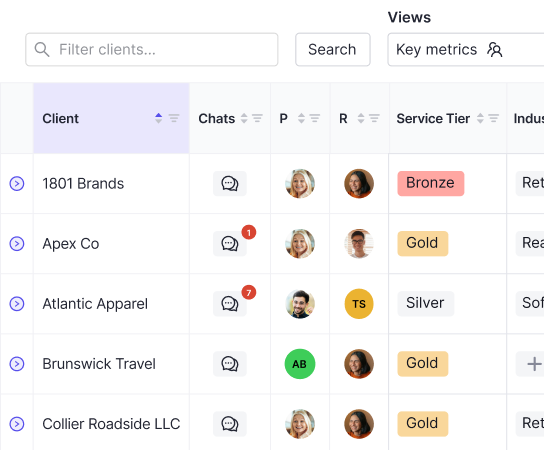
- Multi-client visibility. Firms managing dozens of engagements need a single view showing which closes are complete, which are pending, and where bottlenecks sit, without opening each client file individually.
- Task ownership. Assign preparer, reviewer, and approver roles per client so accountability doesn't depend on memory or a side conversation in Slack.
- Reconciliation automation. Look for tools that flag discrepancies with context instead of a list of outstanding transactions to sort through manually.
Weigh these against onboarding time and per client cost structure, since tools priced per user instead of per client tend to penalize firms as their book grows.
Double's Approach to AI in the Close Process
Double treats AI in the close as an execution engine built directly into the ledger. Bank feed categorization, journal entry drafting, and reconciliation matching post straight to the general ledger through two-way sync, so a completed task updates the books immediately instead of sitting in a separate dashboard. AI Flux Analysis drafts variance explanations at the vendor and transaction level for P&L and Balance Sheet accounts, with configurable materiality thresholds that let each team decide what counts as material enough to flag. Every AI-drafted categorization, entry, or explanation carries a full audit trail back to the source transaction, and a person still reviews the output, approves the numbers, and owns the final sign-off. That structure is what separates Double from tools that only flag issues for someone else to fix: the AI drafts the first pass, and the accountant retains control over what reaches the financials.
Final Thoughts on AI's Growing Place in Accounting
What AI in accounting really changes is your relationship with the data, less time chasing numbers, more time explaining what they mean. That shift takes some structure: clear review steps, defined ownership, and staff trained to question AI output instead of accepting it blindly. Build that foundation now and the next stage of adoption gets a lot easier. Take a look at how it works by booking a demo.