
Your finance team spends hours every month comparing ledgers against bank statements, credit card reports, and vendor invoices to make sure the numbers match. That's bank reconciliation in accounting, and according to Trintech research, it's one of those processes that looks simple on paper but quietly consumes up to 40% of your team's time in practice. The core task hasn't changed: match each transaction in your books against an external source and investigate the gaps. What's changed is the volume, and manual processes don't scale without adding headcount.
TLDR:
- Not every discrepancy is an error: timing differences need no adjustment, but duplicate entries, missing transactions, and data entry mistakes do.
- Common discrepancies include timing differences, data entry mistakes, duplicate entries, and missing transactions like bank fees.
- Manual reconciliation can consume up to 40% of finance team time, but automation cuts that by up to 90%.
- Monthly reconciliation beats quarterly because small errors caught early take minutes to fix instead of hours later.
- Double automates transaction matching and surfaces exceptions so your team reviews what matters instead of checking every line.
What Is Reconciliation in Finance
Reconciliation in finance is the quality-control step between transaction entry and published financial reports. You compare internal ledger records against an external source to verify that what your team recorded matches what actually moved through your accounts, before those numbers feed into statements that inform business decisions.
When the numbers don't line up, investigate that gap. A missing entry, a duplicate charge, a timing difference, an outright error. Catching those discrepancies early keeps your books accurate and prevents small mistakes from compounding into bigger reporting problems later.
Why Reconciliation Matters for Financial Accuracy
Misstated financial reports distort decisions that ripple across an entire business, and errors that go unnoticed in month one tend to compound by month six.
Fraud is the harder conversation. According to the Association of Certified Fraud Examiners, organizations lose 5% of annual revenue to fraud each year. Regular reconciliation catches it early by forcing a comparison between what the books say and what actually moved through your accounts. That kind of oversight makes it much harder for fraudulent activity to hide.
Beyond fraud, auditors expect clean, traceable records. If your financials can't be tied back to source documentation, you're creating a problem that only gets more expensive to resolve.
The Reconciliation Process: Step-by-Step
Every reconciliation follows the same core sequence, regardless of account type.
Gather your source documents first. Pull the internal ledger alongside the external record, whether that's a bank statement, credit card report, or vendor invoice. From there, you compare line by line, matching each transaction in your books against the external source.

What to Watch For at Each Stage
- Flag discrepancies as you go. Timing differences, missing entries, and duplicate charges all surface here, and catching them early saves investigation time later.
- Investigate the gaps before making any changes. Each discrepancy needs a clear answer: is it a legitimate timing difference, or an actual error requiring correction?
- Adjust and document last. Post any necessary journal entries and attach supporting documentation before closing the period.
That sequence holds month after month. A repeatable approach catches more issues before they compound, and when auditors come asking, the trail is already built.
Types of Reconciliation in Accounting
Not all reconciliations work the same way. The core distinction is whether you're comparing records inside your organization or measuring them against an outside source.
Internal reconciliation matches accounts within the same system. External reconciliation checks your books against a third party, like a bank or vendor, where errors cross an organizational boundary before anyone catches them.
Type | What It Compares | Category |
|---|---|---|
Bank reconciliation | General ledger vs. bank statement | External |
Credit card reconciliation | Card transactions vs. statement | External |
Vendor reconciliation | AP ledger vs. vendor invoices | External |
Customer reconciliation | AR ledger vs. customer account | External |
Balance sheet reconciliation | GL balances vs. supporting schedules | Internal |
Each type carries a different risk profile. Bank and credit card reconciliations catch timing differences and unauthorized charges where they're easiest to miss. Vendor and customer reconciliations surface disputes, missing invoices, or payment discrepancies. Balance sheet reconciliation confirms every account balance has documentation to back it up.
Common Reconciliation Discrepancies and Their Causes
Not every discrepancy means something went wrong. Timing differences are the most common culprit: a payment leaves your account on the 28th but clears the bank on the 3rd. Your books show it; the statement doesn't. That gap is normal.
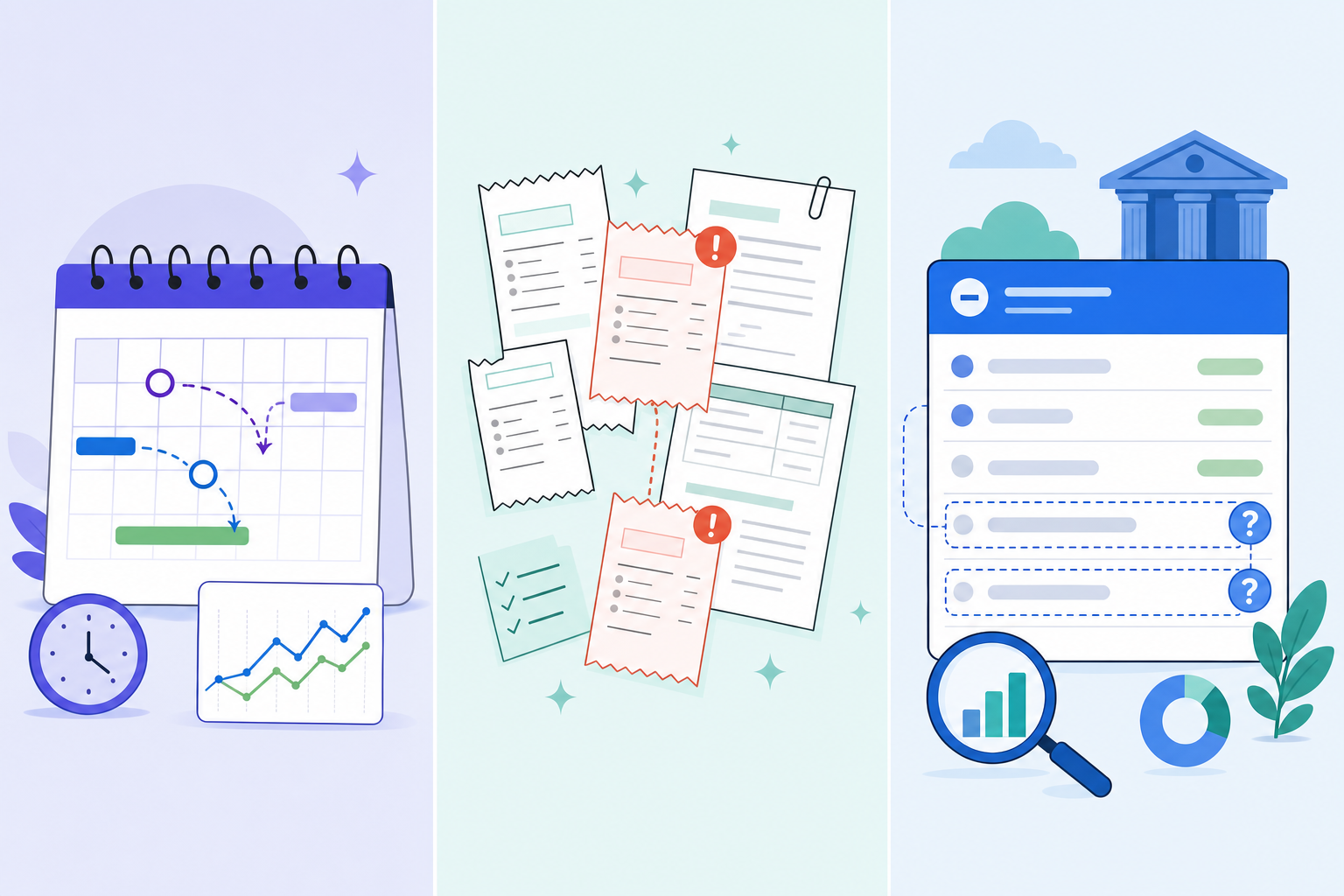
Other discrepancies are actual problems worth investigating:
- Data entry mistakes, like a $1,200 invoice posted as $1,020, where a simple transposition quietly distorts your records.
- Duplicate entries from the same transaction recorded twice, often when a payment gets logged manually and again through an import.
- Missing transactions such as bank fees or auto-drafts that never made it into the ledger.
- Unauthorized charges your team didn't recognize or approve.
The challenge is that all of these look identical before investigation. According to Trintech, manual reconciliation can consume up to 40% of a finance team's time, largely because separating timing differences from real errors requires going line by line through every transaction.
Bank Reconciliation: The Most Common Type
Bank reconciliation compares your general ledger cash balance against your bank statement for the same period. Cash moves daily, and errors here distort every downstream report before anyone notices.
Most differences fall into three categories:
- Outstanding checks: issued and recorded in your books but not yet cleared by the bank
- Deposits in transit: received and recorded internally but not yet posted to your account
- Bank fees or NSF charges: posted by the bank without a matching ledger entry
Timing differences need no adjustment. Bank fees and NSF charges require a journal entry to bring the ledger in line. Knowing which category you are dealing with is what separates a five-minute fix from an hour of digging.
Manual vs Automated Reconciliation
Manual reconciliation works fine at low volume. A few accounts, a modest transaction count each month, and spreadsheets hold up. The process is manageable.
Scale changes that equation. More transactions mean more opportunities for human error, broken formulas, and duplicated effort. Industry estimates suggest cut manual work by 90% by handling data matching and error flagging automatically.
What automation actually changes: discrepancies get surfaced instead of found. Instead of combing through every line hoping to catch something, your team reviews exceptions. That shift matters more as transaction volume grows, because the manual approach simply does not scale without adding headcount.
Reconciliation Best Practices for Finance Teams
Monthly reconciliation beats quarterly every time. Small errors caught early cost minutes to fix. Found three months later, they can cost hours to unwind.
Key practices that scale:
- Set a fixed close date and hold it so the process stays predictable across reporting periods.
- Use standardized templates across your team to reduce variation and make reviews faster.
- Document discrepancies as you resolve them, not after, so the audit trail stays clean.
- Review exceptions first instead of every line manually, focusing attention where it matters most.
How Month-End Close Relies on Reconciliation
Reconciliation sits at the center of every month-end close. Before financial statements can be finalized, every balance sheet account needs a verified, documented balance. That verification comes from reconciliation, and without it, the numbers going into your reports are essentially unconfirmed.
The sequence matters. Bank accounts go first because cash underpins everything else. From there, credit cards, vendor balances, and accrued liabilities follow in order. A single unresolved discrepancy in an earlier account can hold up everything downstream, especially when one balance feeds into another.
Controllers who skip ahead, or treat reconciliation as something to finish after the close, end up reopening periods and reissuing reports. The cleaner path is treating reconciliation as the close itself, not a step that follows it.
How Double Simplifies Reconciliation for Faster Month-End Close
Reconciliation is one of those processes that looks straightforward on paper but quietly eats up hours every month in practice. Chasing discrepancies, cross-referencing ledgers, and manually matching transactions across systems adds up fast.
Double helps finance teams close faster by automating the repetitive matching work that slows month-end down. Instead of toggling between spreadsheets, your team gets a clear view of what matches, what doesn't, and what needs attention.
Visit doublehq.com to see how Double approaches reconciliation for growing finance teams.
Final Thoughts on the Reconciliation Process
Building a solid reconciliation process means your financial reports reflect reality instead of assumptions. You spend less time hunting for errors and more time on work that actually moves the business forward. Month-end close gets predictable when reconciliation happens consistently instead of as an afterthought. If your team is ready to automate the matching work, book a demo and we'll show you how Double fits into your close process.