

Ramp Stack came out in June 2026 with Skills-based AI agents, reconciliation workpapers, and flux commentary built for accounting firms. For clients already on Ramp cards, that native data advantage cuts out the export and import steps most tools require. The structural constraints appear when you're managing ten or twenty concurrent client closes. AI outputs land in spreadsheets, not inside a managed close workflow. There's no client portal. Reporting focuses on single entities instead of multi-client portfolios. The seven Ramp Stack alternatives below were built to close those gaps, and each one makes different assumptions about where your client data lives and how you run your close process.
TLDR:
- Ramp Stack launched June 2026 with Skills-based AI agents for accounting firms, with native data advantage for Ramp card clients
- AI outputs land in spreadsheets with no client portal or multi-client reporting, creating friction for firms managing concurrent closes
- Double executes the full close inside one workspace with two-way QuickBooks Online and Xero sync, client portal, and portfolio views
- Firms using Double report 30 to 50 percent time savings per engagement, with per-client pricing that scales with book size
Top 7 Ramp Stack Alternatives & Competitors in July 2026
Ramp Stack was announced in June 2026 as Ramp's AI product purpose-built for accounting firms. It layers Skills-based AI agents, reconciliation workpapers, flux analysis, and accrual roll-forwards on top of Ramp's existing spend data. For firms whose clients already run on Ramp, that native data access is a real structural advantage.
The limitations worth noting are architectural. AI output lands in spreadsheets instead of a close workflow. There is no client portal. Reporting stays at the single-entity level. For firms managing multi-client portfolios across disconnected systems, those constraints add up quickly.
The seven alternatives below cover the range of tools firms are actively comparing against Ramp Stack right now.
What is Ramp Stack and How Does it Work?
Ramp Stack launched in June 2026 as an AI agent product for accounting firms, built through a design-partner process with more than 4,500 firms.
Data connections include QuickBooks Online with read/write access to the GL, transaction history, and chart of accounts, plus Google Drive and external bank accounts via Plaid. For clients on Ramp's card and bill pay stack, that data arrives natively without any import step. Outside the Ramp ecosystem, those connections require manual setup.
What Ramp Stack Agents Handle
Agents take on a defined set of recurring close tasks each period. Here is what that covers in practice:
- Fixed asset depreciation schedules calculated and posted automatically based on the asset register.
- Prepaid amortization spread across the appropriate periods without manual journal entry work.
- Deferred revenue roll-forwards tracked and recognized according to each client's revenue schedule.
- Journal entry posting routed through the Skills workflow, with configurable checkpoints for human review before anything hits the GL.
Who Ramp Stack Is Built For
The stated target market is accounting firms already running Ramp's card and bill pay products with their clients. That native data advantage is real: when a client lives inside the Ramp ecosystem, transaction data flows directly into the close workflow without any import or sync step. For those firms, the setup friction is genuinely lower than most alternatives.
For firms whose clients are not on Ramp's spend products, that advantage disappears. Bank feeds come in through Plaid, and the broader integration footprint requires more manual configuration to get off the ground.
Why Consider Ramp Stack Alternatives?
Ramp Stack is a genuinely new entrant, announced in June 2026 as Ramp's AI-powered close management offering purpose-built for accounting firms. It brings real advantages: native access to Ramp transaction data, a Skills-based IP model where AI agents are trained on firm-specific workflows, and design-partner development that reflects actual practitioner input.
That said, there are structural realities worth weighing before committing to it as your primary close management tool.
Here are four reasons firms are actively weighing alternatives:
- AI output lands in spreadsheets, not inside a managed workflow. Ramp Stack's reconciliation workpapers and flux analysis are genuinely useful outputs, but they export into spreadsheets instead of feeding into a connected close workflow. For firms running multiple concurrent client closes, that means reassembling context manually across each engagement.
- There is no client portal. Firms that rely on structured client document requests and status tracking need a dedicated portal layer. Ramp Stack does not include one, which pushes that work back into email or a separate tool.
- Reporting is single-entity focused. The current architecture surfaces financials at the individual client level. Firms managing portfolio-level visibility across five, ten, or twenty clients will find the cross-client reporting layer thin.
- The product is early. Ramp Stack launched in June 2026 with a defined feature set. The Skills-based model is promising, but the depth of close automation outside of Ramp-native clients remains unproven at scale.
None of these are reasons to dismiss it outright. For firms whose clients are already on Ramp's spend product, the native data advantage is real. The question is whether that advantage is enough if the surrounding close workflow still requires manual assembly.
Best Ramp Stack Alternatives in July 2026
Ramp Stack launched in June 2026 as Ramp's named AI product for accounting firms, built around Skills-based AI agents, reconciliation workpapers, flux analysis, and accrual roll-forwards. It has a real native data advantage for firms whose clients already run on Ramp cards, and its design-partner development process shows genuine attention to accounting firm workflows.
That said, several structural design choices create friction for firms managing multi-client portfolios. AI output lands in spreadsheets instead of a purpose-built close environment. There is no client portal. Reporting focuses on single-entity views. For firms running five or more concurrent client closes, those gaps add up.
Below are seven alternatives worth considering.
1. Double
Double is built for accounting firms managing multi-client month-end closes, with two-way sync to QuickBooks Online and Xero as its primary integrations. Where Ramp Stack outputs AI-generated workpapers into spreadsheets, Double keeps the entire close inside one workspace: task assignments, transaction matching, flux commentary, and client communication all live together.
The AI inside Double works at the transaction level. It drafts variance explanations for the P&L and Balance Sheet with configurable materiality thresholds, flags uncategorized transactions, and prepares journal entries for review. Firms using Double report saving 30 to 50 percent of close time per engagement.
Pricing follows a per-client model with no user fees or seat charges, which means costs scale with your book of business instead of your headcount.
Four capabilities set Double apart from Ramp Stack in particular:
- A purpose-built client portal where clients submit documents, answer questions, and approve transactions without needing to log into any accounting software or sift through email threads.
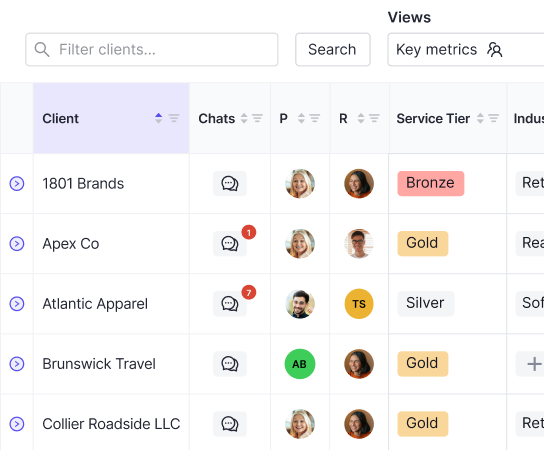
- Multi-client portfolio views that surface which engagements are on track, which are blocked, and which are approaching deadline across every client simultaneously.
- AI flux analysis that auto-drafts variance explanations at the vendor and transaction level, so reviewers start with a draft explanation instead of a blank cell.
- Workpaper and checklist infrastructure that assigns each step to an owner with a due date, tracked inside the close instead of in a separate project management tool.
Ramp Stack is a fit for firms whose clients are already heavy Ramp card users. Double is a stronger fit for firms that need a close environment built around the full accounting workflow, regardless of which spend tool the client uses.
2. Karbon
Karbon is a widely adopted practice management tool that accounting firms use to coordinate work across teams. It handles job tracking, client communication through shared email, and workflow automation for recurring engagements.
The limitation worth noting is structural. Karbon was built to manage firm-wide work coordination, not to execute month-end closes. There is no transaction-level reconciliation, no flux analysis, and no accounting software sync. Firms that want Karbon for pipeline management and a separate tool for close execution often find themselves managing two systems that do not share data.
For firms weighing Ramp Stack alternatives because they want deeper close automation, Karbon covers a different part of the workflow.
3. Jetpack Workflow
Jetpack Workflow is a job management tool designed for small accounting firms. It tracks recurring work, sends deadline reminders, and gives firm owners visibility into what each team member is working on.
The gap relative to Ramp Stack is the absence of accounting-specific automation. Jetpack does not sync with QuickBooks Online or Xero, does not perform reconciliation, and does not generate variance analysis. It is a scheduling and job-status tool, not a close execution tool.
Firms that outgrow spreadsheet-based job tracking often adopt Jetpack as a stepping stone. Firms that want automated close workflows eventually look elsewhere.
4. Financial Cents
Financial Cents is practice management software aimed at small to mid-sized accounting firms. It covers client management, workflow automation, time tracking, and a client portal for document collection.
Like Jetpack, Financial Cents does not integrate directly with accounting software for transaction-level work. The client portal is functional for document requests, but the tool stops before reconciliation and close execution begin. It competes more directly with Karbon and Jetpack than with Ramp Stack.
For firms that want a single tool covering both practice management and close automation, Financial Cents covers the first half of that equation.
5. Canopy
Canopy is a full-practice management suite covering CRM, document management, time and billing, and workflow for accounting firms. Its document management and client portal features are among the more complete options in the firm management category.
The structural limitation in the context of Ramp Stack is the same as with Karbon and Financial Cents. Canopy was designed to run the business of an accounting firm, not to automate the close itself. There is no accounting software sync, no AI-driven reconciliation, and no flux commentary generation inside the tool.
Firms weighing Canopy as a Ramp Stack alternative should be clear about which problem they are trying to solve. If the goal is close automation, Canopy does not solve it. If the goal is practice management alongside a separate close tool, Canopy is worth weighing on its own merits.
6. Numeric
Note: Numeric is built primarily for corporate finance teams managing a single entity, not for accounting firms running multi-client portfolios. It is included here for firms already familiar with Numeric who want to understand where it falls short as a dedicated multi-client close tool.
Numeric covers reconciliation, flux analysis, and close checklists with a clean interface. For an in-house finance team closing one set of books each month, it performs well.
The core limitation is structural. Numeric's architecture assumes one entity per workspace. Accounting firms managing ten, twenty, or fifty concurrent client closes hit friction quickly because the tool was never designed for that operating model. Ramp Stack has a similar single-entity orientation in its early release, which is part of why both tools sit in a different category from Double for multi-client firm workflows.
7. FloQast
FloQast is a close management tool with meaningful market adoption, particularly among mid-market corporate finance teams. It covers reconciliation, flux analysis, audit trails, and ERP integrations including NetSuite and Sage Intacct.
For accounting firms, the fit gap is pricing and audience orientation. FloQast pricing follows a user-based model with multi-year commitments, which creates cost structures that work better for internal finance departments than for accounting firms billing by client. The product was built for corporate controllers, and its workflow assumptions reflect that audience.
Firms weighing FloQast as a Ramp Stack alternative should note that FloQast competes most directly with Double in the close execution category, but serves a different primary audience. For corporate finance teams, it is worth a detailed look. For accounting firms managing multi-client portfolios, the structural and pricing fit is less clear.
Ramp Stack's Core Capabilities
Ramp Stack is Ramp's AI-powered accounting product, announced in June 2026 and purpose-built for accounting firms managing client books on Ramp's spend management infrastructure.
The core offering revolves around a set of AI Skills that automate specific close tasks. Each Skill targets a discrete workflow step without covering the full close end to end.
Ramp Stack covers:
- AI-generated reconciliation workpapers that pull from Ramp transaction data directly, reducing the manual export and formatting work that typically sits between data collection and review
- Flux analysis that drafts variance explanations at the account level, giving preparers a starting point instead of a blank page
- Accrual roll-forwards handled within the close workflow, so accrual schedules stay connected to the underlying transaction activity
- A Skills IP model that lets Ramp package firm-developed workflows as reusable AI assets, which is a meaningful structural advantage for firms that have already invested in building repeatable close processes on Ramp data
Ramp Stack was developed with design partners, which means the early feature set reflects real accounting firm feedback instead of speculative product direction.
The structural constraint worth noting is architectural. Ramp Stack's data advantage is native to Ramp clients. Firms managing clients who use other spend tools, banking relationships, or ERP setups outside Ramp's ecosystem will find the AI Skills produce weaker outputs because the underlying transaction data is not flowing through Ramp's infrastructure. The product also delivers AI output into spreadsheets instead of a purpose-built close workspace, and there is no client portal included in the current offering.
Inside Ramp Stack's Architecture
Ramp Stack is Ramp's AI-powered accounting workflow product, announced in June 2026 and purpose-built for accounting firms. It sits on top of Ramp's existing spend management infrastructure, giving it a native data advantage for clients already running on Ramp's corporate card.
Ramp Stack capabilities
- Skills-based AI agents that can be configured to run specific close tasks, including reconciliation workpapers, flux analysis, and accrual roll-forwards, without requiring manual data exports first.
- A design-partner development model, meaning early features were built in collaboration with accounting firms instead of being retrofitted from a corporate finance product.
- Native access to Ramp transaction data, which removes a common friction point for firms whose clients spend on Ramp cards.
Where the architecture diverges
The core limitation worth noting is structural. AI outputs land in spreadsheets instead of inside a connected close workflow, so there is no built-in client portal, no multi-client reporting view, and no task assignment layer that ties work back to a close checklist. For firms managing five or more concurrent client closes, that handoff creates a gap between where the AI does its work and where the close actually gets finished.
Ramp Stack also assumes single-entity reporting. Firms running multi-client portfolios will hit that boundary quickly, since the product was designed around the Ramp client relationship instead of the firm's working structure across all clients.
Ramp Stack's Key Features
Ramp Stack is Ramp's AI-powered accounting workflow product, announced in June 2026 and built expressly for accounting firms. It sits on top of Ramp's existing spend data infrastructure, giving it a native data advantage for clients who already run their expenses through Ramp.
- Skills-based AI agents that perform discrete accounting tasks such as reconciliation workpapers, flux analysis, and accrual roll-forwards, instead of acting as a general-purpose assistant
- An IP model where accounting firms can encode their own methodologies into reusable Skills, creating proprietary workflow logic the firm owns and builds on over time
- A design-partner development process, meaning early features were shaped in collaboration with accounting firms instead of built speculatively
- Reconciliation workpapers that generate directly from Ramp transaction data, reducing the manual export and formatting work that typically precedes review
Where Ramp Stack diverges from dedicated close management tools is structural. AI output lands in spreadsheets instead of a connected close workflow, there is no client portal for document collection or status visibility, and reporting focuses on single-entity views instead of multi-client portfolio management. For firms running concurrent closes across many clients, those architectural choices create friction at scale.
Ramp Stack's Four Core Capabilities
Ramp Stack ships four core capabilities aimed at accounting firms managing month-end close work for Ramp-connected clients.
The reconciliation workpapers feature pulls transaction data directly from Ramp and generates structured workpaper drafts without manual exports. Flux analysis produces AI-written variance explanations at the account level, giving preparers a starting draft instead of a blank page. Accrual roll-forwards track recurring accrual entries across periods, reducing the repetitive setup work that comes with each new close cycle. The Skills model lets firms encode their own review logic and judgment calls, which Ramp Stack then applies consistently across client engagements.
A few structural details shape how these capabilities land in practice:
- Reconciliation output lands in spreadsheets, not inside a structured close workflow. There is no task assignment, status tracking, or review layer built around the AI-generated workpapers.
- The client portal is absent. Document collection, client communication, and deliverable sharing all happen outside Ramp Stack.
- Reporting stays at the single-entity level. Firms running multi-client portfolios cannot roll up across clients or view cross-entity close status in one place.
- The native data advantage only applies to Ramp clients. For clients using other cards or banks, the reconciliation experience mirrors what any other tool offers.
Ramp Stack is in active development through a design-partner program, so some of these gaps may narrow over time.
Feature Comparison: Ramp Stack vs Top Alternatives
Here is a feature comparison table covering the top Ramp Stack alternatives across the dimensions that matter most for accounting firms choosing close management tools.
Each tool was reviewed based on publicly available documentation, product pages, and user-reported capabilities as of mid-2026. No hands-on trials were conducted for every product listed.
What the Table Covers
The comparison spans seven capability areas that accounting firms consistently weigh when choosing a close management tool: multi-client support, AI-assisted reconciliation, client portal access, ERP integrations, flux analysis, pricing structure, and native data connectivity.

Tool | Multi-Client Support | AI Reconciliation | Client Portal | Leder Integrations | Flux Analysis | Pricing Model | Native Data Source |
|---|---|---|---|---|---|---|---|
Double | Yes | Yes | Yes | QBO, Xero, Sage Intacct, NetSuite | Yes | Per connected client | None required |
Ramp Stack | Limited | Yes (Skills-based) | No | Ramp transactions only | Yes | Add-on to Ramp | Ramp card data |
Karbon | Yes | No | Limited | Limited | No | Per user | None |
Financial Cents | Yes | No | Yes | QBO, Xero | No | Per user | None |
Canopy | Yes | No | Yes | QBO | No | Per user | None |
Keeper | Yes | Limited | Yes | QBO, Xero | No | Per client | None |
Yes | No | Yes | QBO | No | Per staff member | None |
Ramp Stack's native data advantage is real for firms whose clients spend on Ramp cards. The reconciliation and flux outputs are generated from first-party transaction data, which reduces the manual prep step. The structural gap appears when clients use other banks, cards, or ERPs, since Ramp Stack's AI outputs depend on Ramp data being present. For firms managing a mixed client base, that dependency creates uneven coverage across the portfolio.
Why Double is the Best Ramp Stack Alternative
Double is the strongest alternative to Ramp Stack for accounting firms that manage month-end close across multiple clients simultaneously.
Ramp Stack was built around a single-entity assumption. Its AI Skills output lands in spreadsheets, it has no client portal, and its reporting architecture is designed for one set of books at a time. That works well if you are a Ramp card customer closing your own books. It creates friction if you are an accounting firm managing 20, 50, or 100 client closes concurrently.
Double was built for exactly that workflow.
What Double Does Differently
Ramp Stack surfaces AI-generated workpapers that still require manual review and export. Double executes the close inside a connected workflow.
- Reconciliations are matched automatically against live QuickBooks Online and Xero data through two-way sync.
- Flux analysis drafts variance explanations at the vendor and transaction level.
- Accruals, prepaids, and amortization schedules are calculated and posted without leaving the close workflow.
Every client close runs in its own workspace, with task ownership, due dates, and status visibility across your entire portfolio. There is no toggling between spreadsheets, no reformatting AI output for client delivery, and no chasing down which close is behind.
A few things that separate Double from Ramp Stack in practice:
- Firms using Double report saving 30 to 50 percent of close time per engagement, with the gains coming from eliminated data prep, not faster manual review.
- The client portal gives clients a direct channel for document requests and approvals, removing the email back-and-forth that adds days to every close cycle.
- Pricing is per connected client with no user fees or seat charges, so the cost scales with your book of business, not your headcount.
- Two-way sync with QuickBooks Online and Xero means data flows in both directions. Changes made inside Double post back to the ledger without a separate export step.
Ramp Stack has a real advantage for firms whose clients are already on Ramp cards, since native transaction data removes a data ingestion step. If that describes your book, that advantage is worth weighing. Firms managing a mixed or non-Ramp client base will find Double covers the full close workflow without requiring clients to change how they spend.
Final Thoughts on Finding Your Ramp Stack Alternative
Ramp Stack delivers value for firms running Ramp-heavy client books, but the single-entity design and spreadsheet-based outputs create friction when you are managing ten or twenty concurrent closes. Double handles the full workflow from transaction matching to client portal delivery, with two-way sync to QuickBooks Online and Xero. If you need a close tool that works across your entire book regardless of which card your clients use, take a look at Double.