
The accounting method your business uses shapes your taxable income, your financial statements, and your eligibility for certain loans. The choice between cash and accrual accounting has real consequences, and the IRS limits which methods are available depending on your entity type and revenue.
TLDR:
- Cash basis records income when cash arrives; accrual records it when earned, often shifting revenue across tax years.
- The same $8,000 invoice can land in two different tax years depending on which method your business uses.
- C corporations and partnerships with a C corp partner must use accrual once gross receipts exceed $32 million (2026 threshold).
- Switching methods requires IRS Form 3115 and a Section 481(a) adjustment; mid-year switches produce unreliable books.
- Double's Accruals and Prepaids Management calculates recognition amounts and posts journal entries inside the close workflow automatically.
What Is Cash Basis Accounting?
Cash basis accounting records revenue when cash lands in the bank and expenses when cash leaves it. Pay a vendor in April for a January invoice, and that expense belongs to April.
It mirrors your bank statement. No accounts receivable ledger, no accounts payable schedule. Freelancers and solo consultants favor this method since it matches how they track money day to day.
The gap: unpaid invoices and bills stay invisible until cash actually moves, which distorts the picture for complex businesses.
What Is Accrual Basis Accounting?
Accrual accounting records revenue when it's earned and expenses when they're incurred, not when the cash actually shows up. Bill a client in January for work delivered that month, and the revenue posts in January, even if payment arrives in March.
The matching principle drives this. It pairs revenue with the expenses that generated it in the same period, so a January sale sits next to the January cost of goods that made it possible.
That requires tracking what's owed and what's owing: accounts receivable, accounts payable, and accrued expenses journal entries all become part of the books.
Key Differences Between Cash and Accrual Accounting
The two methods diverge across five practical dimensions.
Dimension | Cash Basis | Accrual Basis |
|---|---|---|
Revenue and expense timing | Recorded when money moves | Recorded when earned or incurred |
Accounts receivable and payable | Not tracked | Tracked and reported on the balance sheet |
Matching principle | Not applied | Core requirement |
Complexity and administrative burden | Low, minimal bookkeeping | Higher, requires more detailed records |
GAAP compliance | Not GAAP compliant | Required under GAAP |
Cash basis asks little of you beyond watching the bank balance, while accrual basis demands ongoing tracking of what's owed in both directions and regular general ledger reconciliation. That extra effort buys statements that reflect the true economic activity of a period, beyond the cash that happened to clear.
GAAP compliance settles the question for a specific set of businesses. Public companies, and any business seeking outside investment or a bank loan of meaningful size, generally need accrual basis statements because GAAP requires it.
Cash vs Accrual Accounting: Side-by-Side Examples
Picture a consulting firm that finishes a project and sends an $8,000 invoice on November 20. The client pays on January 15, crossing into a new tax year. Under cash basis, that $8,000 counts as January income. Under accrual basis, it counts as November income, the month the work was delivered and billed.
Event | Cash Basis | Accrual Basis |
|---|---|---|
Invoice sent (Nov 20) | No entry | Revenue recorded: $8,000 |
Payment received (Jan 15) | Revenue recorded: $8,000 | No entry (already recorded) |
Tax year affected | Year 2 | Year 1 |
Same $8,000, same client, two different tax years depending on the method chosen.
Pros and Cons of Cash Basis Accounting
The cash method earns its popularity for good reason. Here is where it helps, and where it stops helping.
Advantages
- Simple enough to run without a bookkeeper or accounting software background
- Lower bookkeeping overhead since there is no accounts receivable or payable ledger to maintain, an area where accounting automation can reduce effort further
- Direct visibility into cash flow, since the books show what is in the bank
- Flexibility to time income and deductions across tax years, deferring invoices or prepaying expenses before year end
Disadvantages
- Can distort results in a given period, since unpaid invoices do not show up as income yet
- Not GAAP compliant, ruling it out for audited financials
- Limited usefulness for investors or lenders wanting statements reflecting obligations as they occur
Pros and Cons of Accrual Basis Accounting
Accrual basis carries more weight administratively, but it gives you a truer read on performance. Here is where it earns its keep, and where it costs you.
Advantages
- Matches revenue to the expenses that generated it in the same period, so each month reflects true economic activity rather than cash timing
- Meets GAAP requirements, which public companies and businesses seeking outside investment or sizable bank loans generally need
- Shows a fuller financial picture by tracking accounts receivable and accounts payable, so obligations in both directions stay visible
- Supports better forecasting and decision-making, since earned revenue and incurred costs surface before the cash moves
Disadvantages
- Higher bookkeeping burden, since you track receivables, payables, and accrued items on top of cash movement
- Cash position can be harder to read at a glance, because recorded revenue does not mean the money has arrived
- Period-end work grows, with prepaid amortization, depreciation, and deferred revenue schedules to calculate and post each close
Tax Implications: Cash vs Accrual Accounting
Choosing between cash and accrual accounting shapes when income and expenses hit your federal tax return, and that timing can shift a tax bill into a different year. Cash basis lets you delay invoices or prepay expenses to control timing. Accrual basis locks in recognition once income is earned or an expense is incurred, a principle central to the month-end close process.
As of 2026, the IRS gross receipts threshold under IRC Section 448(c) sits at $32 million, per Revenue Procedure 2025-32, up from $31 million in 2025.
Who Cannot Use the Cash Method of Accounting
Under IRS rules, C corporations and partnerships with a C corporation partner must use accrual accounting once average annual gross receipts cross the Section 448(c) threshold. Businesses where inventory drives income generally fall under the same requirement, since cash basis has no way to track goods on hand. Tax shelters are excluded outright regardless of size.
Outside those categories, flexibility stays wide. S corporations, sole proprietors, and partnerships without a C corporation partner can generally pick cash basis under the gross receipts threshold, per IRS Publication 538.
The Modified Cash Basis: A Hybrid Accounting Method
The modified cash basis splits the difference. A business books inventory and cost of goods sold on accrual, matching purchases to the sales they support, while everything else, rent, utilities, one off expenses, stays on cash basis and posts only when money moves.
IRS Publication 538 permits this combination as long as it clearly reflects income and gets applied the same way every year. It suits businesses that hold inventory but don't want the full weight of accrual bookkeeping across every account, including preparing a depreciation journal entry.
On Schedule C, this method gets declared under the "Other" box in the accounting method section, since neither "Cash" nor "Accrual" captures a blended approach.
How to Choose the Right Accounting Method for Your Business
Choose based on five factors:
- Transaction volume and complexity
- Inventory on hand, including any deferred revenue obligations
- Lender or investor GAAP requirements
- Entity type and gross receipts versus the Section 448(c) threshold
- Industry norms, since project-based fields like construction often need accrual regardless of size
If none of these factors apply to your business, cash basis accounting works fine and keeps your books simple.
How to Switch Accounting Methods
Switching from cash to accrual, or the reverse, requires filing IRS Form 3115, Application for Change in Accounting Method, with the tax return for the year of the change. This isn't optional paperwork. The IRS treats a change in accounting method as a formal event, and skipping the filing can jeopardize the switch entirely.
A Section 481(a) adjustment comes with it. This spreads out the difference between the two methods, catching income or expenses that would otherwise get counted twice or missed altogether, over one or more tax years depending on the size of the adjustment.
The switch takes effect at the start of a new tax year. Flipping methods mid-year won't produce clean books.
Many changes qualify for automatic consent under IRS procedures, which sounds simpler than it is. Automatic still means a complete Form 3115 package with the correct designated change number and required disclosures. Given the stakes of the Section 481(a) calculation, this is worth handling alongside a CPA and not on your own.
How Double Handles Accrual Accounting Inside the Close Workflow
Accrual accounting works in theory until period end arrives and someone must calculate every prepaid expense amortization, depreciation schedule, deferred revenue split, and loan amortization by hand.
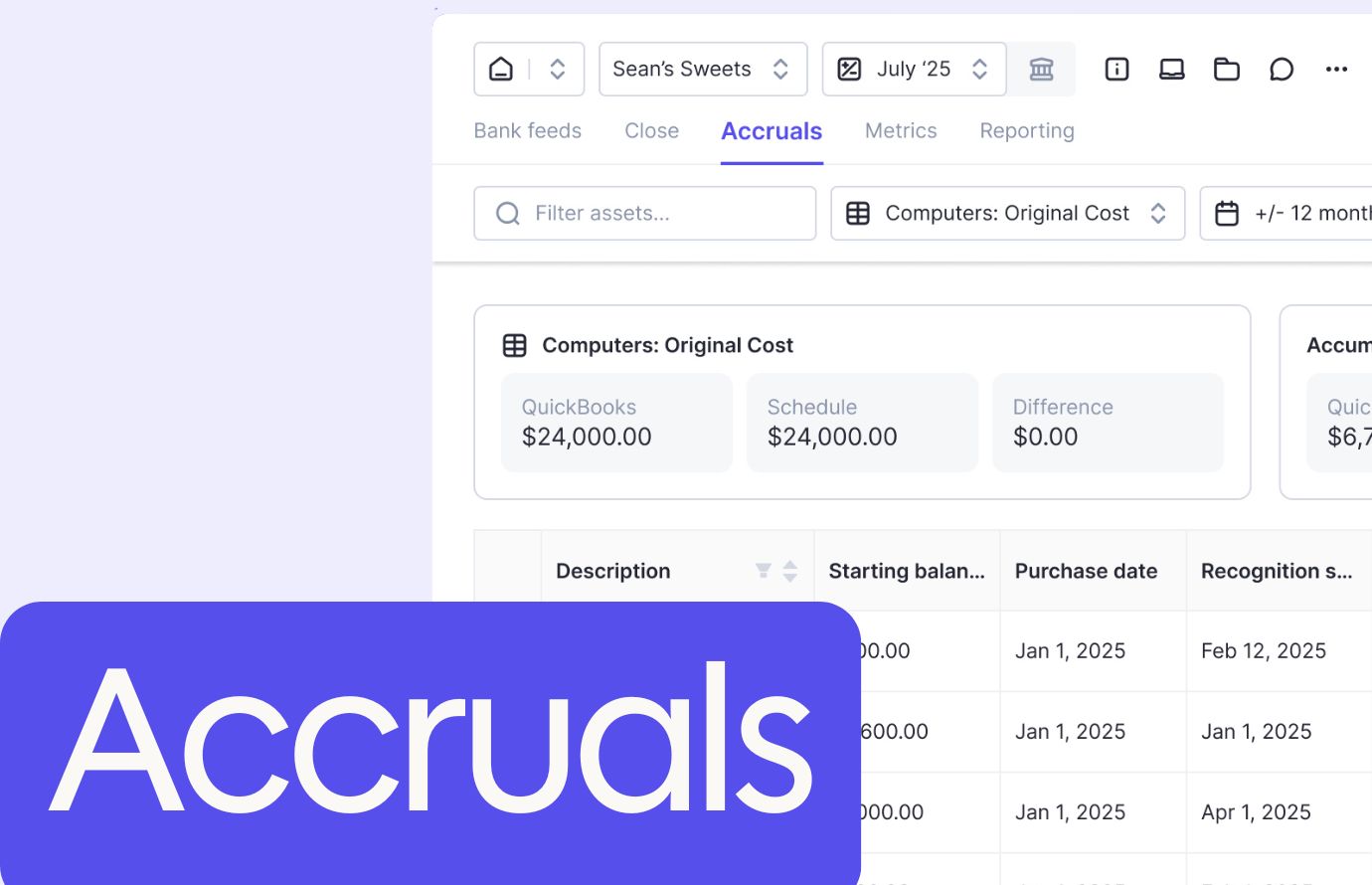
Double's Accruals and Prepaids Management handles this inside the close for firms on QuickBooks Online and Xero and finance teams on Sage Intacct and NetSuite. It calculates recognition amounts for prepaid expenses, fixed assets, deferred revenue, and loan amortization schedules, then prepares and posts the journal entries automatically. Each schedule carries a full audit trail, and entries post directly to the ledger without leaving the close workflow. The result is a period-end accrual process that runs on a defined schedule, independent of whoever remembers to open the spreadsheet.
When questions arise during the close, such as which clients have outstanding accrual schedules, whether a prepaid balance ties to the general ledger, or which tasks still need sign-off, Ask Double answers them against live ledger data and then executes the follow-on action from the same conversation: creating and assigning tasks, posting transactions, or retrieving activity logs across the book of business. Available on Core, Plus, and Scale plans (with transaction creation via chat on Scale for QuickBooks Online clients), it eliminates the manual lookup work that typically interrupts the accrual close while keeping human review and sign-off at every step.
Final Thoughts on Cash Basis vs Accrual Basis Accounting
Most businesses don't pick an accounting method so much as grow into the one that fits. Cash basis earns its place for simple operations, but once your business carries obligations in both directions, accrual gives you the full picture. Knowing the IRS rules, your entity type, and your gross receipts puts you in a much better position to pick the right method and stick with it. Book a demo with Double to see how the accrual close gets handled inside a single workflow.