
Your books can look completely different depending on when you record revenue and expenses, which is exactly why accruals and deferrals matter. One pulls recognition forward, the other pushes it back, and mixing them up can quietly distort your financial statements in ways that aren't obvious until close. Here's how the two concepts actually work and where each one belongs.
TLDR:
- Accruals record revenue or expenses before cash moves; deferrals delay recognition until after cash moves.
- Accrued revenue and accrued expenses are assets and liabilities respectively, earned or incurred but not yet settled.
- Deferred revenue sits on the balance sheet as a liability until the service is delivered; deferred expenses sit as assets until consumed.
- Misclassifying deferred income as earned revenue overstates earnings and understates liabilities, creating audit exposure.
- Double's Accruals and Prepaids Management calculates recognition amounts and posts journal entries automatically to QuickBooks Online and Xero for accounting firms, and Sage Intacct and NetSuite for corporate finance teams.
Accrual vs. Deferral: The Core Distinction
Accrual accounting and deferral accounting solve the same timing problem from opposite ends: matching revenue and expenses to the period they actually belong to, no matter when cash moves.
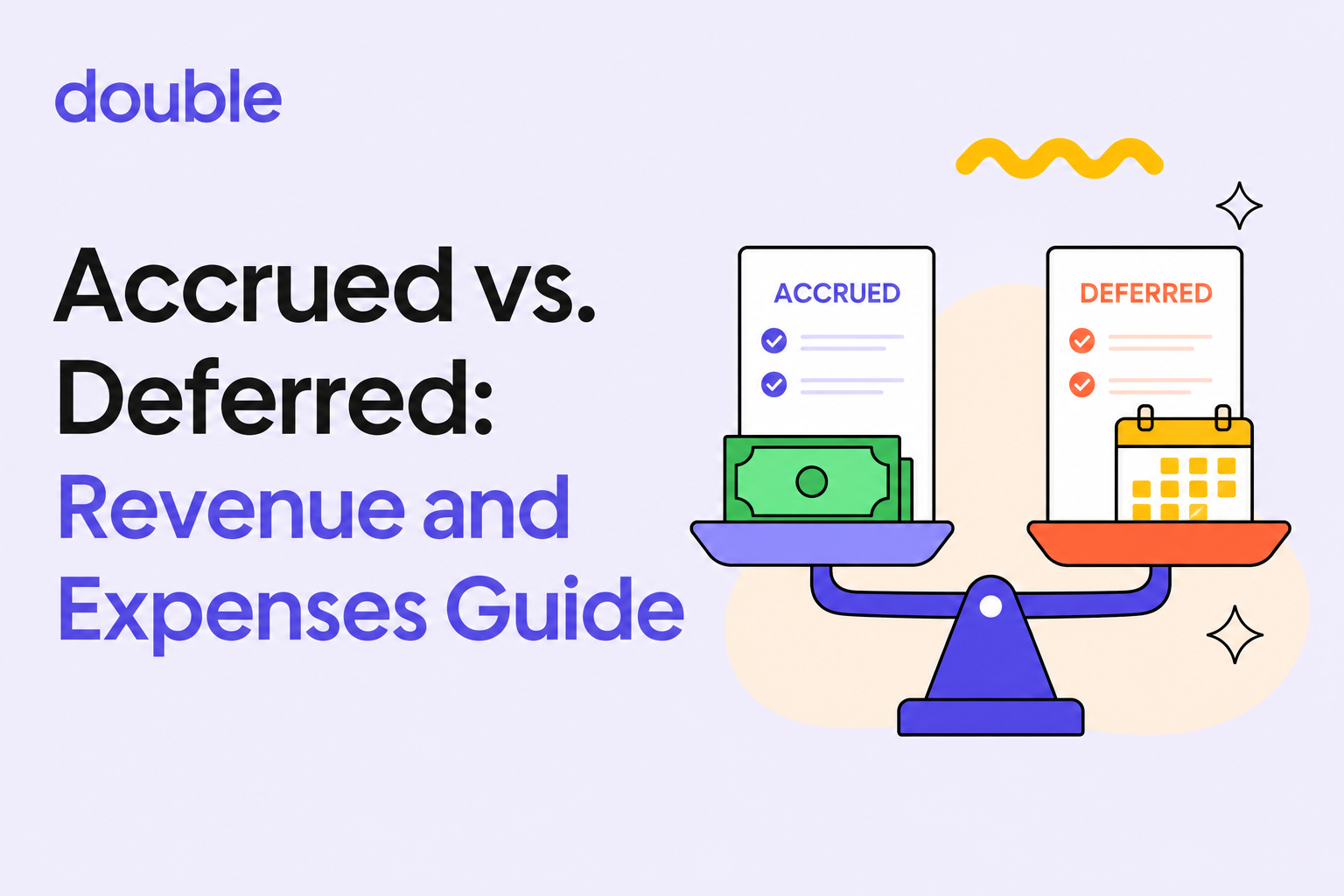
An accrual records revenue or an expense before cash changes hands. Deferral works in reverse: cash has already moved, but the revenue or expense hasn't been earned or used up yet, so recognition waits for a later period.
Accruals pull recognition forward. Deferrals push it back. Ask two questions: has cash moved, and has the work been done?
What Is an Accrual in Accounting?
An accrual records economic activity in the period it happens, regardless of when cash arrives or leaves. That's the meaning behind "accrued" in accounting: work has been done or a cost has been incurred, and the books need to reflect it now, not later. GAAP requires this under FASB's matching principle and the revenue recognition rules in ASC 606, which tie recognition to when goods or services are delivered, not when payment clears.
Accruals split into two categories:
- Accrued revenue is money earned but not yet received. A consulting firm that finishes a project in February but doesn't invoice until March still records the revenue in February, since that's when the work was actually done.
- Accrued expenses are costs incurred but not yet paid. A company that uses electricity in December but doesn't get the bill until January still books the expense in December, matching the cost to the period it was actually used.
What Is a Deferral in Accounting?
A deferral records economic activity later than when cash moves. Cash arrives or leaves first, and recognition waits until the company actually earns the revenue or consumes the benefit it paid for.
Deferrals split into two categories, mirroring accruals but pointed the other direction.
- Deferred revenue is cash received before the company delivers what it promised. A software company collecting $1,200 upfront for a one year subscription hasn't earned that money yet. That obligation sits on the balance sheet as a deferred revenue liability until service is provided.
- Deferred expenses (prepaid expenses) are cash paid before the benefit is used. A company paying $6,000 for a six month insurance policy holds a resource with future value, recorded as an asset until coverage is used.
Deferred revenue means the company owes performance. Deferred expenses mean the company holds something unused.
Accrued vs. Deferred Revenue
Both accrued revenue and deferred revenue involve a mismatch between when cash moves and when the income statement records revenue, but they sit on opposite sides of that gap. Accrued revenue is an asset: work has been delivered and revenue has been earned, but the invoice hasn't been sent or paid yet. Deferred revenue is a liability: cash has arrived, but the company hasn't yet delivered the goods or services it owes.
The balance sheet treatment makes the distinction concrete. Accrued revenue lands as a receivable-like asset because the company holds a valid claim to future payment. Deferred revenue lands as a current liability because the company owes future performance. Collecting cash before earning it doesn't create income; it creates an obligation.
Recognition timing drives the difference. Accrued revenue gets recognized the moment performance is complete, regardless of whether an invoice exists. Deferred revenue stays off the income statement until delivery happens. A $1,200 annual subscription collected upfront releases $100 to revenue each month as service is delivered, not all at once when payment clears.
Accrued vs. Deferred Expenses
Accrued expenses and deferred expenses land on opposite sides of the balance sheet, even though both deal with costs.
An accrued expenses journal entry records a liability when the company used a good or service but hasn't paid for it yet. Wages earned in late December but paid in January's payroll are one example. Interest accruing on a loan between payment dates is another.
A deferred expense is an asset: the company already paid, but the benefit isn't used up yet. Prepaid rent is a common one, and prepaid insurance works the same way, with the unused policy portion sitting on the books until consumed month by month.
"Deferred expense" and "prepaid expense" often get used interchangeably. One distinction: prepaid expenses are typically current assets consumed within twelve months, while a deferred expense can stretch beyond a year into long-term assets.
Accrual and Deferral Journal Entries
Every accrual or deferral adjustment follows the same mechanical rule: one entry hits the income statement, the other hits the balance sheet, and cash never moves in the adjusting entry itself.
For accrued revenue, the entries look like this:
Transaction | Debit | Credit |
|---|---|---|
Revenue earned, not yet invoiced | Accrued Revenue (asset) $5,000 | Service Revenue $5,000 |
Cash received later | Cash $5,000 | Accrued Revenue $5,000 |
For deferred revenue, the sequence runs in reverse: cash lands first, and recognition follows as the work gets done. A $1,200 upfront subscription hits Cash and Deferred Revenue (liability) at receipt; each month, $100 moves from Deferred Revenue to Service Revenue as service is delivered.
Expense-side entries mirror this logic. An accrued expense books the cost before payment, then clears the liability when cash goes out: debit Utilities Expense $300 / credit Accrued Liabilities $300 when the cost is incurred, then debit Accrued Liabilities $300 / credit Cash $300 when the bill is paid.
A deferred expense books the asset at payment, then recognizes it as it gets used: debit Prepaid Insurance $6,000 / credit Cash $6,000 at purchase, then debit Insurance Expense $1,000 / credit Prepaid Insurance $1,000 each month as coverage is consumed.
Accrued vs. Deferred Taxes
Accrued taxes deal with timing of a known bill. Deferred taxes deal with permanent mismatches between book and tax reporting. Payroll, income, and property taxes owed but unpaid are accrued liabilities, mechanically identical to accrued expenses.
Deferred taxes arise from temporary book-tax differences:
- Fixed assets under accelerated tax depreciation versus straight-line GAAP depreciation (see depreciation journal entry examples for how these entries differ)
- Accrued liabilities deductible only once settled, not when booked
- Intangible assets with mismatched cost recovery and amortization schedules
Per PwC, the deferred tax model recognizes current and future tax consequences of book income within the same period, aligning two different questions about one year.
Accrued vs. Deferred Interest
Accrued interest is interest that has been earned or incurred but not yet paid or received. A company carrying a loan records interest expense each month as it accrues, even though the actual cash payment may not leave the account until the end of the quarter. That monthly journal entry debits Interest Expense and credits Accrued Interest Payable, keeping the income statement matched to the period the obligation actually belongs to.
Deferred interest works in reverse: cash moves first, and recognition waits. A lender who collects interest upfront, or a borrower who receives a prepaid interest arrangement, parks the unearned portion on the balance sheet as a liability until the service period it covers has passed. The balance releases to the income statement period by period as the underlying time or performance obligation is satisfied.
The balance sheet treatment signals the difference. Accrued interest is a current liability (or current asset for the lending side) because it represents an obligation that has already accumulated. Deferred interest sits as a liability because the recognizing party hasn't yet earned or used the value it has been paid for. Both affect the income statement in the period they belong to, though they arrive there from opposite directions.
How Accruals and Deferrals Affect Financial Statements
Each accrual or deferral entry ripples across all three statements, beyond the one where it's booked.
Accrued revenue lifts assets and net income before cash arrives, since it adds a receivable-like balance and matching revenue in the same period, even though the cash flow statement won't show cash from operations until later. Deferred revenue does the opposite: it inflates current liabilities and holds income statement recognition back, so earnings dip below what the collected cash might suggest.
Accrued expenses raise liabilities and reduce net income in the period the cost belongs to, keeping the income statement matched to actual activity. Deferred expenses shrink current assets gradually, as the prepaid balance converts into expense month by month.
Misclassifying deferred income as earned revenue overstates earnings and understates liabilities, both audit red flags that surface during general ledger reconciliation. Skipping an accrued expense understates liabilities and overstates income in the same stroke, creating the same exposure from the opposite direction.
Accrued vs. Incurred: Clearing Up the Confusion
"Incurred" and "accrued" sound interchangeable, but they describe two different moments in the accounting cycle. A cost is incurred the instant the underlying activity happens: when employees work a shift, when electricity runs through a building, when a vendor delivers a service. Incurring is an economic event. Accruing is the bookkeeping response to that event: it's the journal entry that records the cost on the books before cash goes out.
Every accrued expense has been incurred, because you can't record a liability for something that hasn't happened yet. But not every incurred cost is immediately accrued. A company that ignores its December utility bill until the invoice arrives in January has incurred the expense in December but failed to accrue it. The result: December's income statement overstates profit, and the balance sheet omits a real liability. Under GAAP, the matching principle closes that gap by requiring the accrual entry in the period the cost belongs to, not the period the bill arrives.
Why GAAP Requires Accruals and Deferrals
Under GAAP, both principles work together to keep the income statement accurate. The matching principle requires expenses to be recorded in the same period as the revenues they relate to, which is exactly what accruals and deferrals enforce. Consider a common scenario:
- A company collects $12,000 upfront for a one year service contract. That cash is a deferral. It sits on the balance sheet as unearned revenue and moves to the income statement in monthly $1,000 increments as the service gets delivered.
- That same company owes $3,000 in wages for work employees already performed but haven't been paid for yet. That's an accrual. It hits the expense line immediately, even though cash hasn't left the account.
Neither adjustment is discretionary. Skipping either one means the books no longer reflect when value was actually earned or consumed, which is why both items belong on any month-end close checklist.
How Double Handles Accruals and Deferred Revenue at Month-End
Accruals and deferrals stop being abstract once they become monthly close tasks. They are recurring adjusting entries that eat hours in spreadsheets, a problem covered in depth in managing accruals manually in Excel, and they are where errors hide until an auditor finds them.
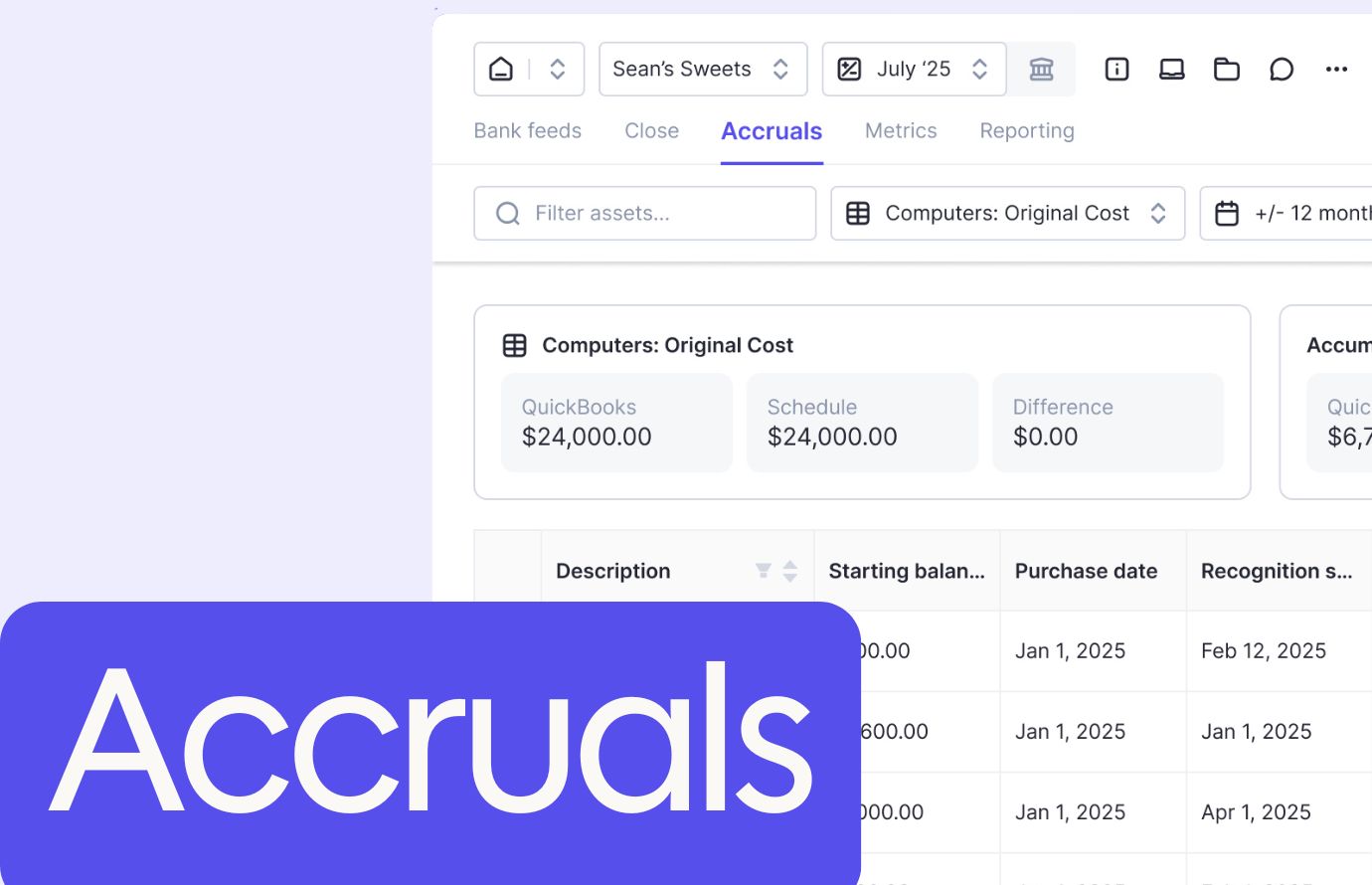
Double's Accruals and Prepaids Management feature handles prepaid expense amortization, fixed asset depreciation, deferred revenue schedules, and loan amortization inside the close workflow. Double calculates recognition amounts, prepares journal entries, and posts them automatically to the general ledger as part of a broader approach to automate financial close, posting to QuickBooks Online and Xero for accounting firms, and Sage Intacct and NetSuite for corporate finance teams. Every accrual action gets logged in the Activity Log with a full audit trail.
Controllers get catch-up periods for mid-period onboarding, reusable presets, and GL-to-schedule reconciliation that checks ledger balances against the underlying schedules. All of these steps fit into a structured month-end close process, turning the adjusting entry workflow into a reviewable step instead of a spreadsheet marathon, as part of the broader shift from point solutions to integrated close management.
When questions come up mid-close (why a prepaid balance looks off, which clients have open deferred revenue schedules, or whether a recognition period needs adjusting) Ask Double can query ledger data on demand and surface answers grounded in the actual figures, without pulling up reports manually. It can also create accrual and loan amortization schedules directly from chat on the Scale plan, so the setup work that normally lives in a spreadsheet or a separate module stays inside the same close workflow. Ask Double is included on Core, Plus, and Scale plans, with usage limits that vary by tier.
Final Thoughts on Accrual and Deferral Accounting
The difference between accrued and deferred comes down to timing: accruals recognize activity before cash moves, deferrals wait until after. Both keep your books tied to economic reality, not your bank balance. If managing these entries each month feels like a spreadsheet problem waiting to happen, book a demo with Double to see the adjusting entry workflow in action.